Burning, tingling or the feeling of stepping on a small stone between your toes can be symptoms of Morton’s neuroma. We explain what it is, why it happens and what treatments are available.
If you notice a burning pain between your third and fourth toes, tingling that reaches the tips of your toes, or the feeling of having a small stone in your shoe, you may have a Morton’s neuroma. It is a common cause of pain in the front of the foot.
What is a Morton’s neuroma?
Between the long bones of the foot (the metatarsals) run nerves that go to the toes. When one of them is repeatedly compressed or rubbed, it thickens and becomes irritated. That thickening is the neuroma. It most often appears between the third and fourth toes, although it can also occur between the second and third.
Symptoms
- Burning or stabbing pain in the sole, between the toes.
- Tingling, numbness or cramp that spreads into the toes.
- A feeling of stepping on a lump or a stone.
- Relief when you take off your shoe and massage the area.
- Worse in narrow or high-heeled shoes.
Why does it happen?
It is more common in women and is usually linked to narrow or high-heeled shoes, which squeeze the metatarsals and overload the front of the foot. The shape of the foot, the way you walk and high-impact activities for the forefoot, such as running or certain sports, also play a part.
How we diagnose it
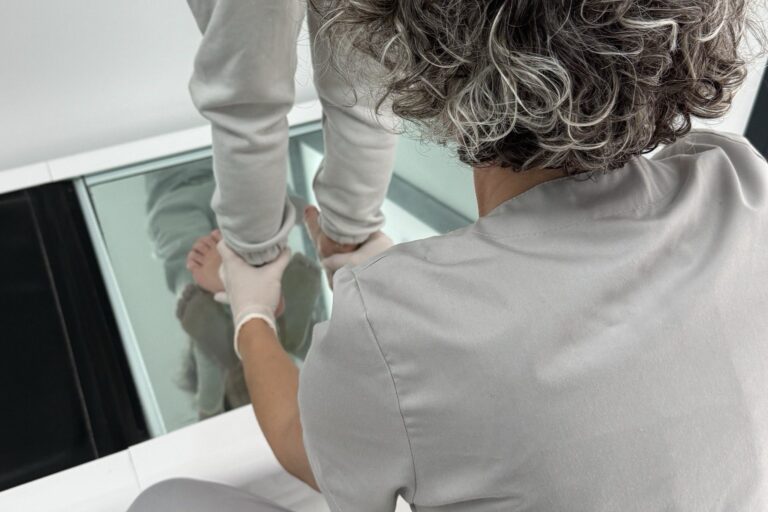
We start with an examination: we locate the painful spot and carry out tests that reproduce the symptoms. Ultrasound at the clinic lets us see the neuroma, measure it and rule out other causes of forefoot pain, such as bursitis or overloaded metatarsals.
Treatment
In most cases we start with conservative treatment:
- Shoes that are wide at the toes and have a low heel.
- Custom insoles with offloading that spreads the metatarsals and takes pressure off the nerve.
- Injections when the pain persists, to reduce the inflammation around the nerve.
If the pain does not settle with these measures, surgery is considered, which nowadays can be carried out with minimally invasive techniques.
Frequently asked questions
Is it a tumour?
No. Although it is called a «neuroma», it is not a tumour: it is a thickening of the nerve caused by repeated compression and rubbing.
Will it go away on its own?
It rarely disappears on its own if the cause remains. Changing your footwear and using a good insole usually relieves the symptoms a great deal.
Do the injections hurt?
You feel a brief prick. We carry them out with the proper hygiene and technique, and we explain beforehand what you will feel.
When is surgery needed?
Only when the pain persists despite footwear, insoles and injections. We assess it with you according to your case.
This article is for general information and does not replace an in-person assessment. If you have symptoms, book an appointment and we will look at your case.